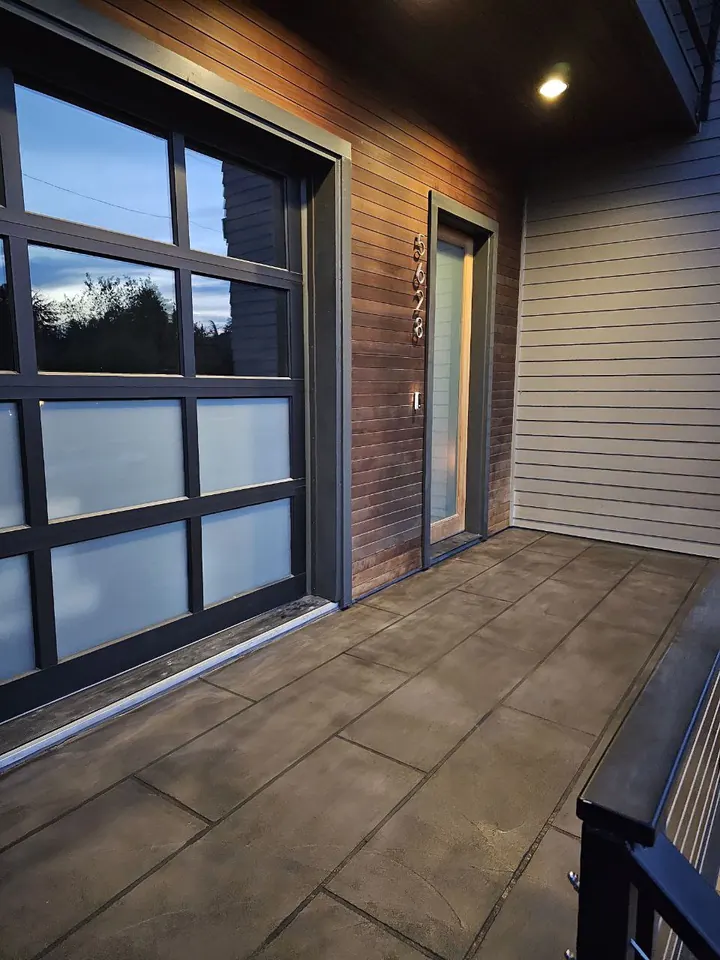
When homeowners ask us about waterproofing a deck or balcony, the conversation almost always lands on two names: Westcoat ALX and Westcoat ALX Pro. They look the same when they are finished. Both give plywood the look and feel of concrete, both are sealed with the same acrylic topcoat, and both carry the same fire ratings. The difference is hidden inside the system, and it matters for certain decks.
This guide compares the two systems layer by layer: what each one is built from, where the extra membrane in ALX Pro goes and what it does, the fire and code listings, what the plywood underneath has to look like, how each system is maintained, and how the warranties work. Every technical detail comes from Westcoat's published ALX Standard Finish and ALX Pro Standard Finish system specifications and the Westcoat product pages. If you want a broader introduction first, start with our guide to what the Westcoat ALX Pro system is.
The Short Answer
ALX Pro is standard ALX with one extra layer: a fiberlath-reinforced resin membrane embedded between the base coat and the slurry coat. Westcoat describes ALX Pro as ideal for decks with spans of ten feet or more and for cases where additional crack resistance and flexibility are essential. Westcoat's ALX brochure says the added membrane guards against cracking on larger spans of unreinforced substrates. ALX Pro is also the version Westcoat offers with up to a 20-year manufacturer warranty when it is installed to specification by a Westcoat qualified applicator.
Standard ALX is still a complete waterproof walking deck system. Westcoat calls it ideal for heavy-traffic areas and for decks where hiding the plywood seams is essential, and designed it for balconies, corridors, stairs and landings.
Side-by-Side Comparison
| Feature | ALX (Standard) | ALX Pro |
|---|---|---|
| System type | Waterproof walking deck system | Waterproof walking deck system with an added fiberlath-reinforced membrane |
| Substrate | Plywood | Plywood |
| Sheet membrane on plywood seams | Required (6 inch WP-40) | Required (6 inch WP-40) |
| Full-deck sheet membrane | Optional (36 inch WP-40) | Optional (36 inch WP-40) |
| Reinforcing lath | WP-25 metal lath or WP-30 glass lath | WP-25 metal lath or WP-30 glass lath |
| Fiberlath-reinforced resin membrane | Not included | Included (WP-47 fiberlath in WP-90 resin mix) |
| Cementitious coats | Base, slurry and texture coats | Base, slurry and texture coats |
| Topcoat | SC-10 Acrylic Topcoat, two coats | SC-10 Acrylic Topcoat, two coats |
| Approximate finished weight | About 2½ lbs per sq ft | About 2½ lbs per sq ft |
| Westcoat's stated best use | Heavy traffic; hiding plywood seams; balconies, corridors, stairs and landings | Spans of ten feet or more; extra crack resistance and flexibility; balconies, corridors and landings |
| Class A fire test (ASTM E-108) | Meets | Meets |
| One-hour fire rating (ASTM E-119) | Meets | Meets |
| Class I vapor retarder (ASTM E96) | With WP-40 over the entire deck | With WP-40 over the entire deck |
| IAPMO evaluation | ER-587 | ER-587 |
| Inspect / reseal (Westcoat) | Inspect every 2 to 4 years; reseal every 3 to 5 years | Inspect every 2 to 4 years; reseal every 3 to 5 years |
| Warranty with 360 Surfaces | Up to 20-year warranty, in writing | Up to 20-year warranty, in writing |
Layer by Layer: How Each System Is Built
Both systems start with the same deck preparation and end with the same finish. Here is the full ALX Pro buildup from the plywood up. Standard ALX uses every layer in this list except the fiberlath resin membrane.
Source: Westcoat ALX Standard Finish and ALX Pro Standard Finish system specifications.
1. Flashing
Westcoat requires a minimum of 26-gauge bonderized sheet metal: 4 x 6 inch "L" flashing where the wall meets the deck and 2 x 4 inch drip edge at the fascia. Ends overlap at least four inches, and every seam gets two beads of WP-53 Hybrid Sealant. Flashing is what carries water off the deck and away from the framing, and poorly flashed edges and wall junctions are a common source of leaks on failing decks.
2. Sheet membrane
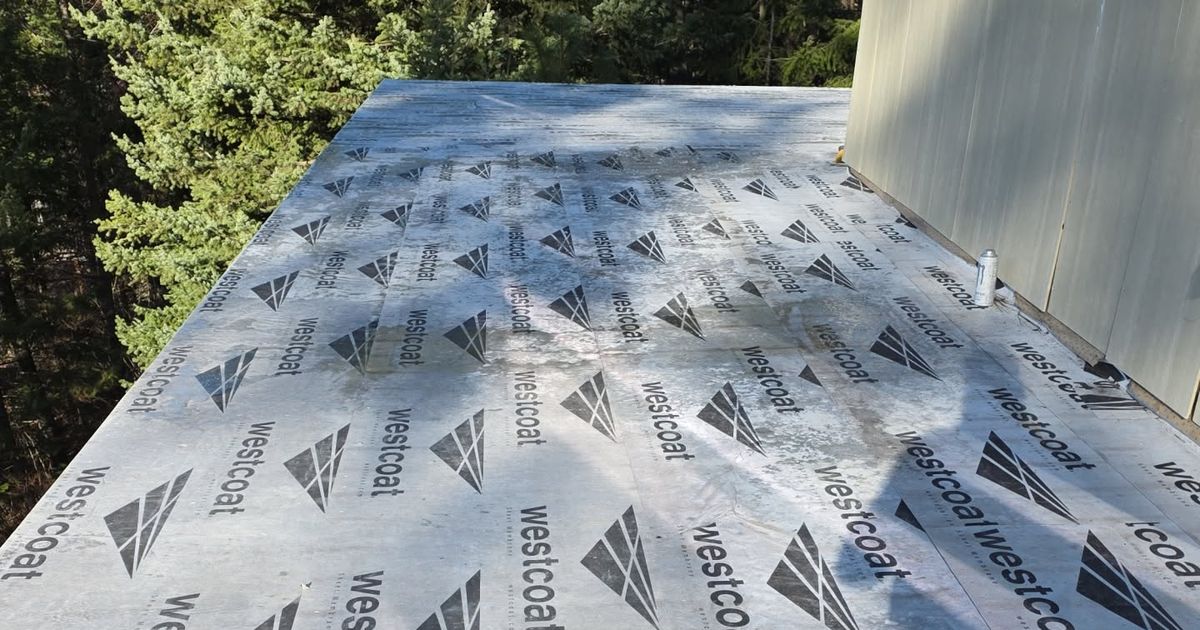
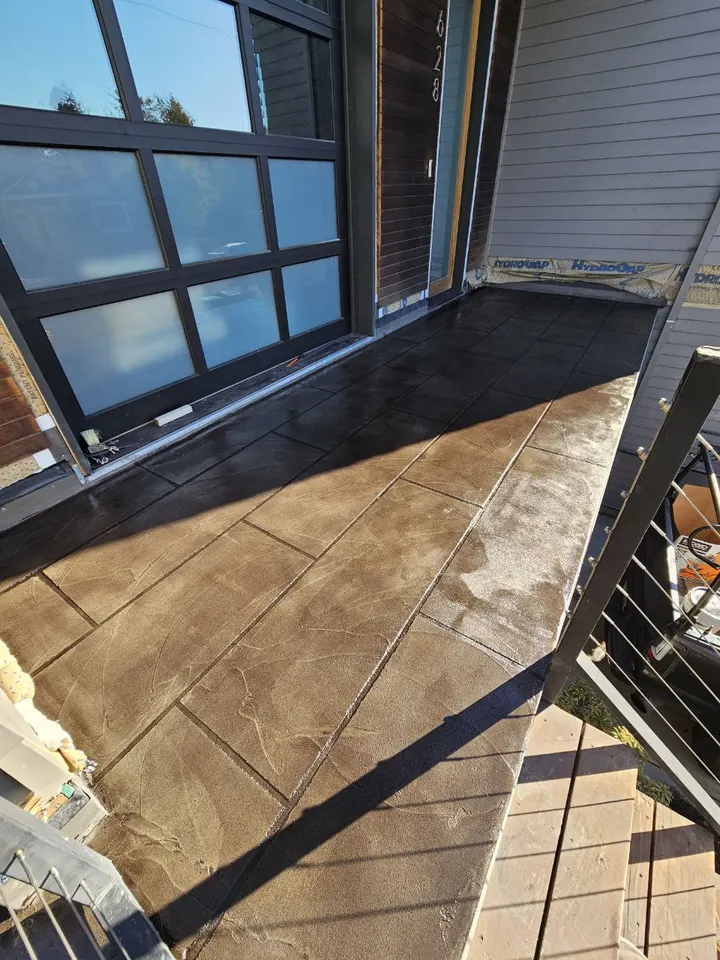
On both systems, Westcoat requires 6 inch WP-40 Sheet Membrane on every plywood seam. For maximum protection, 36 inch WP-40 can be applied across the entire deck, which is what you see in the photo at the top of this page. WP-40 can also go behind or on top of the flashing as a backup waterproofing measure. Westcoat notes that WP-40 should not be left exposed to the sun for more than seven days, so the rest of the system has to follow promptly.
3. Lath
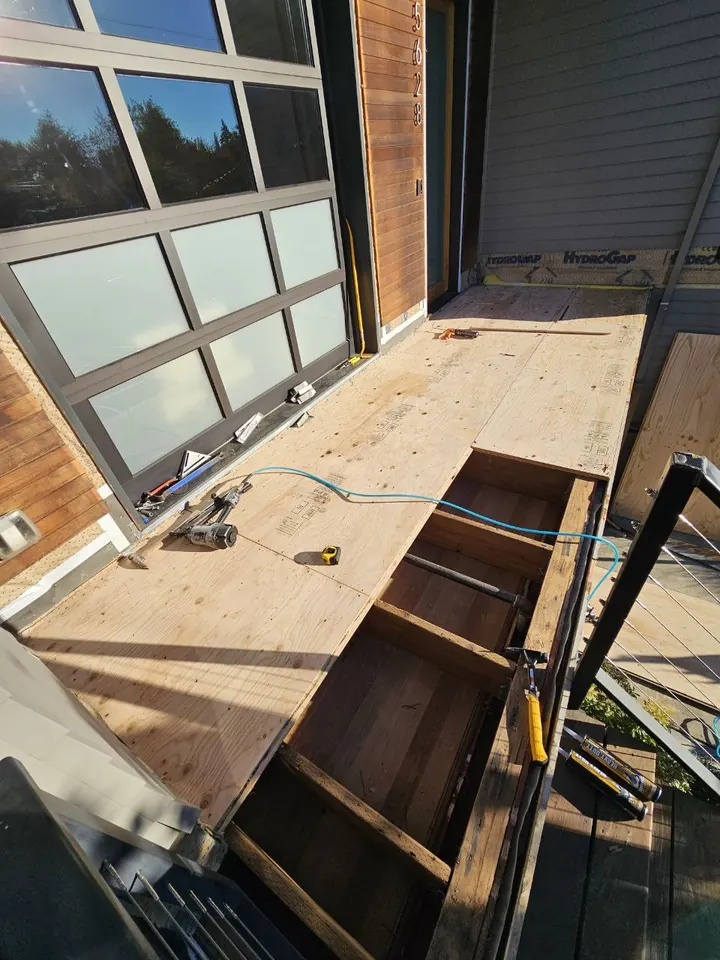
Either WP-25 metal lath or WP-30 Westcoat Glass Lath is stapled to the plywood with 16 to 20 staples per square foot. Westcoat recommends the glass lath for maximum protection against corrosion and calls it a rust-free alternative to metal lath. The lath is what anchors the cement layers to the deck.
4. Base coat
TC-1 Basecoat Cement mixed with WP-81 Cement Modifier is troweled into the lath until it is smooth with the top of the lath. Once dry, high spots and trowel ridges are scraped off before the next layer.
5. Fiberlath resin membrane (ALX Pro only)
This is the layer that makes ALX Pro what it is. WP-47 Fiberlath reinforcing mesh is laid over the base coat with overlapping seams, then a mix of TC-1 cement and WP-90 Waterproofing Resin is troweled thin into the mesh. Westcoat describes WP-90 as a high-solids acrylic-polymer resin with waterproofing characteristics, good flexibility and adhesion. The result is a reinforced, flexible membrane sandwiched inside the system, which is where ALX Pro's added crack resistance comes from.
6. Slurry coat
A smooth slurry of TC-1 cement and WP-81 modifier is troweled over the whole surface and brushed onto the flashing, then any ridges or trowel marks are scraped or ground off once it dries.
7. Texture coat
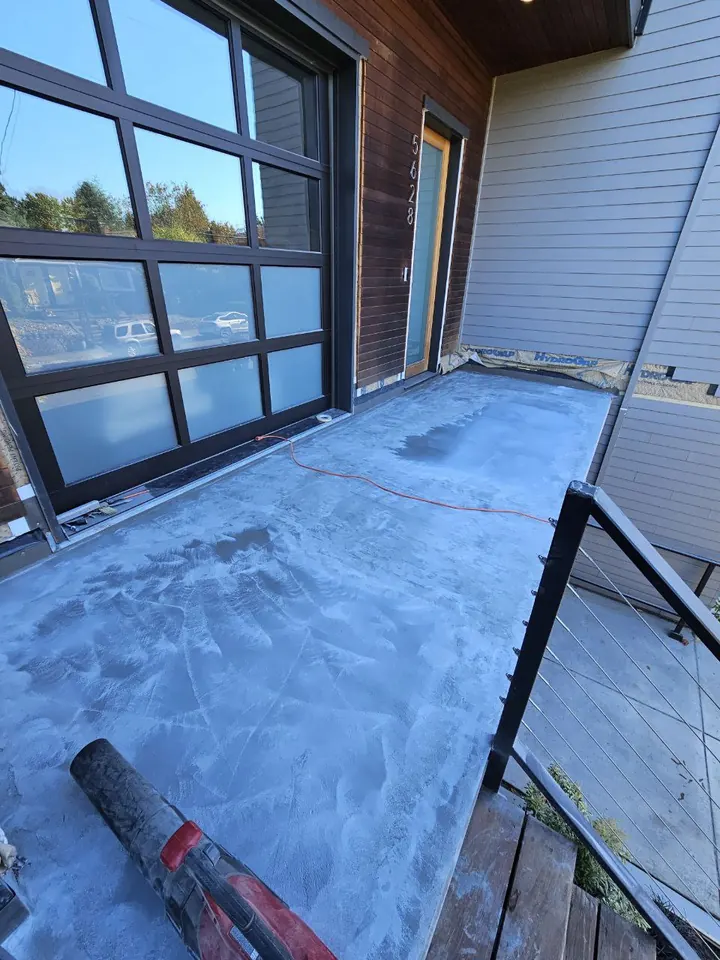
The texture coat sets the look and feel. Westcoat offers finer textures (TC-2 Smooth Texture or TC-5 Grout Texture) and coarser ones (TC-1 Basecoat or TC-3 Medium Texture). It can be troweled, sprayed or broomed, and it is also where decorative patterns such as tile, slate or stone looks are created.
8. SC-10 Acrylic Topcoat
Two thin coats of SC-10 are rolled on in two directions. Westcoat describes the final coat as UV resistant. Because sealers can make a surface slippery, Westcoat highly recommends a slip-resistant additive (its Safe Grip additives mix into the SC-10) on any surface that may get wet, which describes nearly every outdoor deck in the Pacific Northwest.
Membrane vs. Standard: What the Extra Layer Actually Changes
It is easy to assume that ALX Pro is "the waterproof one" and standard ALX is not. That is not how Westcoat describes them. Both are listed as waterproof walking deck systems, and both rely on the same sheet membrane at the seams, the same flashing details and a minimum slope of 1/4 inch per linear foot to shed water.
What the fiberlath resin membrane adds is reinforcement and flexibility across the whole deck surface. Plywood decks move. They expand and contract with temperature and moisture, and longer spans flex more under load. A reinforced, flexible layer inside the system helps it handle that movement without cracking. That is why Westcoat points ALX Pro at decks with spans of ten feet or more and at situations where extra crack resistance and flexibility are essential.
The sheet membrane is a separate question from ALX vs. ALX Pro. Seam membrane is required on both. Full-deck WP-40 is an option on both, and it is what earns the Class I vapor retarder rating under ASTM E96 (0.1 perm or less in Westcoat's test data). On a deck over a living space, an office or a finished garage, we usually recommend talking through full-deck membrane, whichever system you choose.
Fire Ratings and Code Listings
On fire performance, the two systems are listed the same way. According to Westcoat's specifications, both ALX and ALX Pro:
- Meet the Class A fire test (ASTM E-108)
- Meet a one-hour fire rating (ASTM E-119)
- Pass the burning brand test for deck structures (ASTM E2726) and the under-deck fire test (ASTM E2632) in Westcoat's test data
- Meet Wildland Urban Interface (WUI) requirements
- Are evaluated under IAPMO ER-587
Westcoat also lists compliance with the 2020 City of Los Angeles building and residential codes and California's SFM 12-7A-4 decking standard. Those are California listings. Building codes in Washington and Oregon are set at the state and local level, so if your project needs a permit or a specific fire rating, confirm the requirements with your local permit office before work begins. Westcoat's own specifications say decks should meet local building codes.
What the Deck Underneath Has to Be
Neither system can fix a bad substrate. The plywood requirements in Westcoat's specifications are identical for ALX and ALX Pro:
- Plywood: minimum 5/8 inch, with 3/4 inch preferred, CDX or exterior grade, tongue and groove, fully blocked and nailed (glued and screwed is best).
- Framing: maximum joist span of 16 inches and deflection less than L/360.
- No OSB. Westcoat states that OSB is not a suitable substrate. Pressure-treated lumber requires a check with Westcoat before application.
- Slope: at least 1/4 inch per linear foot for drainage.
- Dry wood: typically under a 10% moisture reading, or no moisture under a plastic sheeting test. Westcoat says not to apply over wet plywood.
- Venting: moisture vapor can collect below the waterproofing membrane, so venting has to be added, following local code requirements.
Both systems can be stapled through most old deck systems as a way to rehabilitate problem surfaces. In practice, we only do that after confirming the structure below is sound. If there is soft plywood or rot, it gets opened up and repaired first. Our guide to deck dry rot repair in Vancouver, WA explains what that looks like, and signs your deck is failing covers the warning signs.
Installation Weather in the Pacific Northwest
Both systems use the same acrylic and cement products, so the weather limits are the same. Westcoat says not to apply below 50°F or above 90°F, not to let the products freeze, and not to apply the topcoat if rain is forecast within 48 hours or heavy dew within 24 hours. Rain washes away uncured acrylic products, so decks are covered when weather threatens. That is why we tent decks during the wet months, as described in our post on deck coating in Pacific Northwest rain.
After the final coat, Westcoat calls for 4 to 6 hours at 70°F before light foot traffic, 24 hours before heavy traffic, 48 hours before heavy objects such as furniture or planters go back on, and 5 days before any abrasion or chemical exposure. Cooler temperatures stretch those times.
Maintenance Is the Same for Both
Westcoat's care instructions are identical for ALX and ALX Pro:
- Sweep, and rinse with water and a broom.
- For grease or heavier dirt, use a degreaser diluted 20:1 with water and a soft-bristle brush or broom, then rinse well.
- For calcium or lime buildup, brush on diluted 100-grain vinegar and rinse off the residue.
- Inspect the system for wear every 2 to 4 years.
- Reseal with the appropriate Westcoat sealer every 3 to 5 years, depending on foot traffic and UV exposure.
Resealing on schedule is the single biggest thing a homeowner can do to keep either system performing. Sun and traffic wear the topcoat over time, and a fresh seal coat protects the cement layers and membrane underneath.
Warranty: Where the Two Systems Differ
360 Surfaces is a Westcoat Qualified Contractor Applicator. Westcoat's brochure states that ALX Pro is available with up to a 20-year warranty when installed per specification by a Westcoat qualified applicator, and the ALX Pro product page lists an optional 20-year warranty.
Here is how coverage works on the decks we install. Decks with Westcoat ALX or ALX Pro get up to a 20-year warranty, in writing. The manufacturer term depends on the system and how it is built, and we put the exact terms in writing with your estimate. For more detail, read our guide to deck coating warranties.
Which System Should You Choose?
Standard ALX can be a good fit for smaller decks, landings and stairs with a solid, well-framed plywood substrate and normal residential traffic.
ALX Pro is usually the better choice when:
- The deck or balcony has spans of ten feet or more.
- The deck sits over a living space, a garage or anything else that must stay dry.
- You are restoring a deck that has already cracked or leaked.
- You want the longest manufacturer warranty Westcoat offers on these systems.
On a real project, the answer comes from looking at the deck: the span, the framing, the slope, the flashing and what is underneath. We walk the deck, check the plywood and moisture, and recommend the system and membrane option that fits. You get the recommendation and the warranty terms in writing. To see finishes and recent projects, visit our deck coating page, and if the deck needs new railing, we install cable, glass and aluminum railing as part of the same project.
Frequently Asked Questions
Is standard Westcoat ALX waterproof?
Yes. Westcoat describes both ALX and ALX Pro as waterproof walking deck systems. ALX Pro adds a fiberlath-reinforced resin membrane for extra crack resistance and flexibility, which Westcoat recommends for spans of ten feet or more.
Do ALX and ALX Pro look different when finished?
No. Both use the same texture coat options and the same SC-10 Acrylic Topcoat, so the same finishes and patterns are available on either system. The difference is inside the system.
Do both systems have the same fire ratings?
Yes. Westcoat lists both as meeting the Class A fire test (ASTM E-108), a one-hour fire rating (ASTM E-119) and Wildland Urban Interface requirements, under IAPMO ER-587. Confirm local requirements with your permit office.
Can ALX Pro go over OSB?
No. Westcoat states that OSB is not a suitable substrate for either system. The deck needs minimum 5/8 inch (3/4 inch preferred) CDX or exterior-grade plywood.
What warranty comes with an ALX Pro deck?
Decks with Westcoat ALX or ALX Pro get up to a 20-year warranty, in writing.
Request a Deck Coating Estimate
We install Westcoat ALX and ALX Pro waterproof deck systems on decks, balconies and landings across Vancouver, Clark County and the Portland metro. Request an estimate online or email info@360surfaces.com, and we will inspect the deck and recommend the right system in writing.
360 Surfaces
Published November 15, 2026
Where We Do This Work
Deck repair and waterproof coatings across Clark County and the Portland metro:
Vancouver, WA · Camas, WA · Battle Ground, WA · Ridgefield, WA · Salmon Creek, WA · Washougal, WA · Brush Prairie, WA · Hazel Dell, WA · La Center, WA · Longview, WA · Portland, OR · Lake Oswego, OR · Beaverton, OR · Happy Valley, OR · West Linn, OR · Hillsboro, OR · Tigard, OR · Gresham, OR