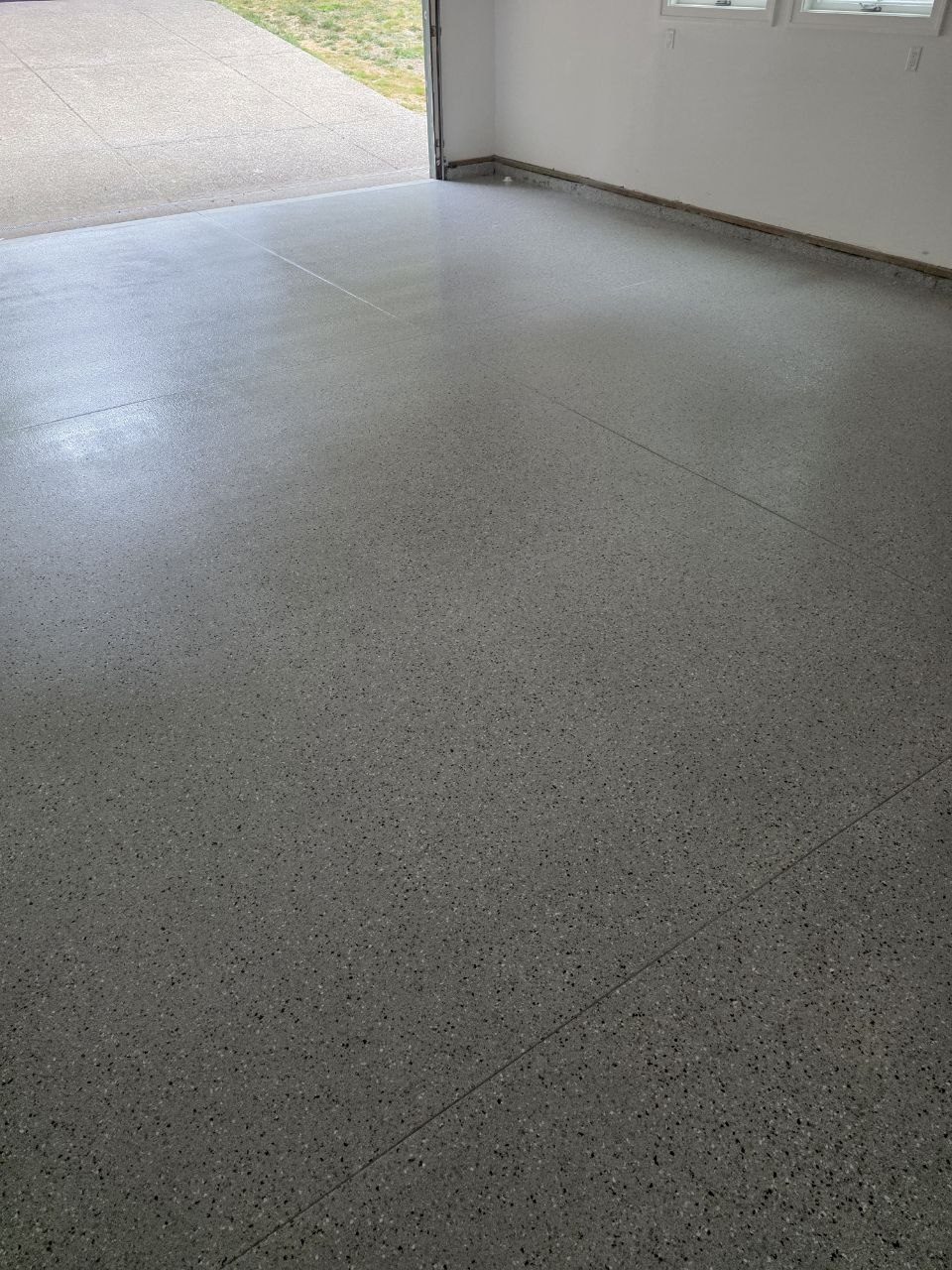
The typical Milwaukie garage was built for one 1950s car. It is small, often detached, and the slab is thin and sloped toward the door with at least one coat of old paint over 60 years of oil. Half the ones we look at in Ardenwald, Hector Campbell, and Lewelling are not going to hold a car again. They are becoming gyms, woodshops, art studios, and offices, and the owner wants a floor that is clean, sealed, and does not dust.
Flake epoxy is a good fit for a conversion because it seals the oil in, stops the dusting, and takes rubber mats, a workbench, or an easel without staining. It is also a good fit for the garage that stays a garage. The bridge trip is about 30 minutes via I-205 or through Portland, and a Milwaukie one-car is a short install, so we can often pair it with another job nearby.
Sealing Sixty Years of Oil Under a Studio Floor
Oil that has soaked into concrete for decades comes to the surface when you grind, and it will fight any coating that goes over it. Diamond grinding removes the saturated top layer along with the paint, and on a badly stained slab we degrease and grind again. Then 100% solids epoxy seals what is left. That is the difference between a floor that stays down and a kit that lifts over the oil spots in a year.
The slope toward the door stays. Epoxy at 100% solids holds on a small garage pitch without running, and a full flake broadcast with a polyaspartic topcoat gives a uniform 30 to 40 mil surface from the back wall to the threshold. Milwaukie sits low near the Willamette and stays damp through winter, so every one of these old slabs, none of which have a vapor barrier, gets a moisture test and often a mitigating primer.
Our Epoxy Flake Floors System
Materials: 100% solids epoxy base, full flake broadcast, Flake Lock, polyaspartic topcoat
Thickness: 30-40 mils
Install time: 2-3 days
Walk on it: 1-2 days after
Park on it: about a week after
Warranty: 5 years on workmanship
Hot-tire pickup resistant. Chemical and impact rated.