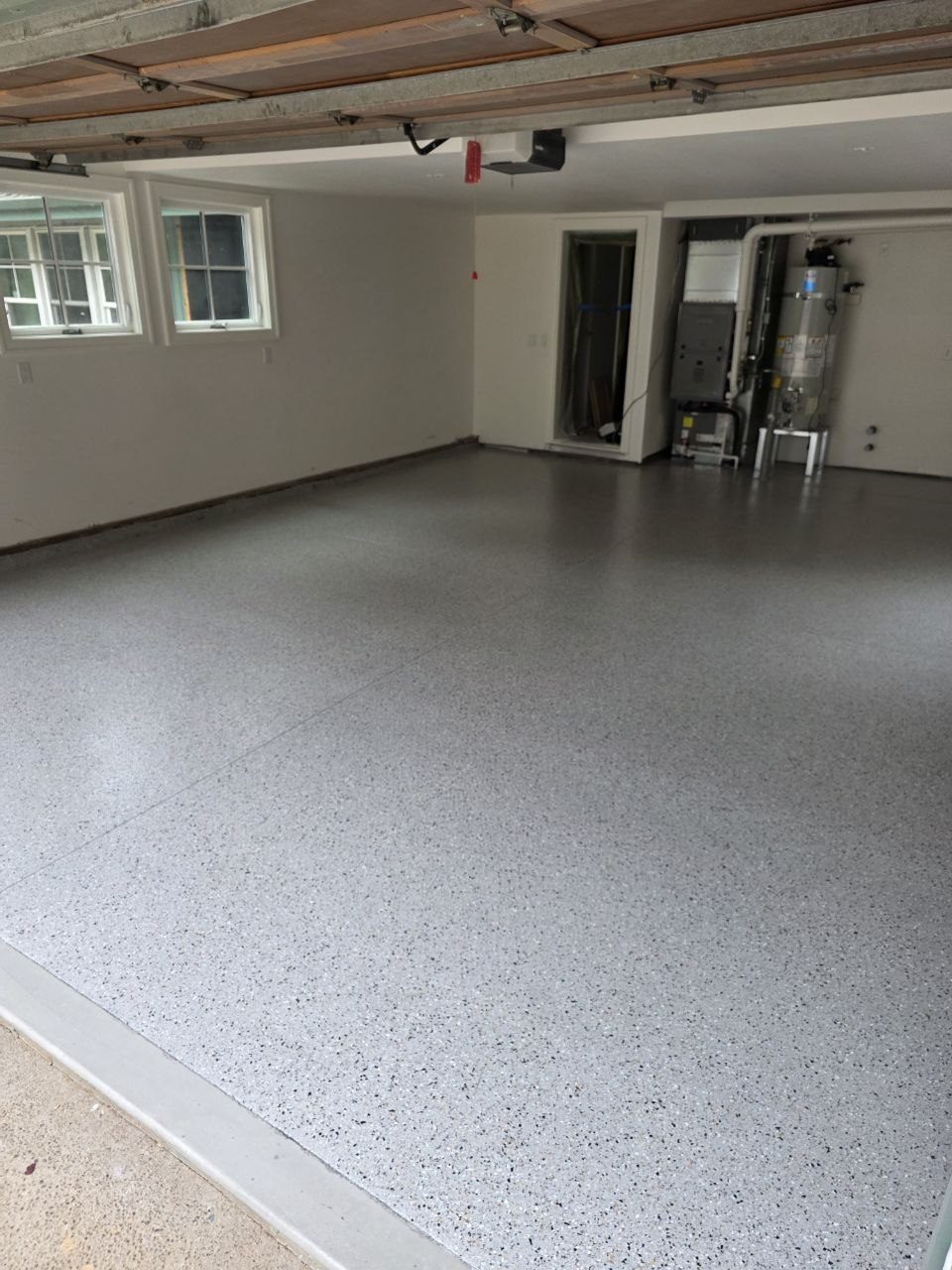
The garage in a 2015 house on Scouters Mountain or Eagle Landing is about to become a gym, a home office, or both. Before the rubber mats and the rack go in, the floor needs to be something other than a gray builder sealer over a slab that may still be drying out. That sealer is the first problem. It is cheap, it is thin, and nothing bonds to it. We take it off completely by diamond grinding or dustless shot blasting, picked for the space.
The second problem is moisture. Happy Valley is nearly all 2005 to 2024 construction, and machine-troweled slabs from the last several years carry both curing compound and high moisture. The meter comes out on the first visit. About 30 minutes down I-205 from our shop, so the estimate visit, the grind day, and the topcoat day are three easy trips.
A Gym Floor That Also Takes a Car
A flake floor at 30 to 40 mils handles dropped dumbbells, a rack bolted through it, and the car that still parks on the other half. The polyaspartic topcoat resists the sweat and chalk and the hot tires equally. Rubber mats go right on top without staining it, which they will do to bare concrete. And when the gym phase is over and the garage goes back to being a garage, the floor is still the floor.
Underneath is the standard system: 100% solids epoxy locked into a diamond-ground or shot-blasted profile, a full flake broadcast, then the topcoat. If the moisture reading is high, which it often is on a slab under five years old, a moisture-mitigating primer goes down first. The Happy Valley hills get a little more rain and wind than the valley floor, and cool nights in spring and fall slow the cure, so we time the topcoat for the warm middle of the day.
Our Epoxy Flake Floors System
Materials: 100% solids epoxy base, full flake broadcast, Flake Lock, polyaspartic topcoat
Thickness: 30-40 mils
Install time: 2-3 days
Walk on it: 1-2 days after
Park on it: about a week after
Warranty: 5 years on workmanship
Hot-tire pickup resistant. Chemical and impact rated.