When a garage floor coating peels, it almost never starts as a mystery. The film lets go of the slab — at an edge, under a hot tire, or in a sheet across an old patch of paint — because it was sitting on the concrete instead of bonded into it.
Homeowners around Vancouver, WA and the Portland metro ask us about this after a kit job, a one-day crew, or an inherited gray-painted floor that has started to lift. This guide explains why coatings peel, what hot tire pickup actually is, and how dustless shot blasting — paired with diamond grinding — gives epoxy a mechanical bond. We prepare concrete by diamond grinding or dustless shot blasting, never acid etching.
If you want the full build of a professional flake floor, see our epoxy flake floors page. If you are weighing a kit against a full install, read DIY Garage Epoxy vs Professional Install.
Coatings Fail at the Bond Line
Most peeling is not a color problem, and it is not usually a bad batch of product. It is a bond problem. Concrete that comes from the builder, or that has been parked on for years, often has a weak, smooth top layer. It may also carry curing compounds, old sealers, gray floor paint, oil and grit. A new coating rolled over that surface has nowhere solid to grab.
A coating is only as strong as its bond. Proper preparation is the single biggest difference between a floor that lasts and one that peels. Peeling almost always traces back to poor preparation. Diamond grinding or shot blasting opens the surface of the concrete so the epoxy mechanically locks in, which is why we never skip or shortcut that step.
When prep is skipped, the coating forms a skin on top of whatever was already there. That skin can look fine for a while. Then a hot tire, a wet Pacific Northwest winter, meltwater at the garage door, or ordinary daily traffic starts to lift an edge. Once an edge lifts, the rest of the film has a place to start.
What Hot Tire Pickup Actually Is
Hot tire pickup is one of the most common ways a poorly bonded floor announces itself. A warm tire softens a thin coating and pulls it off the concrete as it cools. It happens to thin coatings put down on concrete that was never properly prepared.
That is why a professional garage system is built as more than a single rolled-on film. We prepare every slab by diamond grinding or shot blasting so the epoxy bonds into the concrete, and we finish with a polyaspartic topcoat made to handle hot tires. The prep gives the base coat something to lock into. The topcoat is the wear layer that takes the daily heat, oil and abrasion. If a floor was only acid etched, or simply washed and painted, there is no real profile under that film. The tire does not have to destroy the product. It only has to soften it enough to peel it off a surface it never gripped.
The Usual Reasons a Garage Coating Lets Go
Not every peeling floor failed for exactly the same reason, but the pattern is consistent. The product gets blamed first. The surface under it is usually the real story.
Old paint, sealers and oil left in place
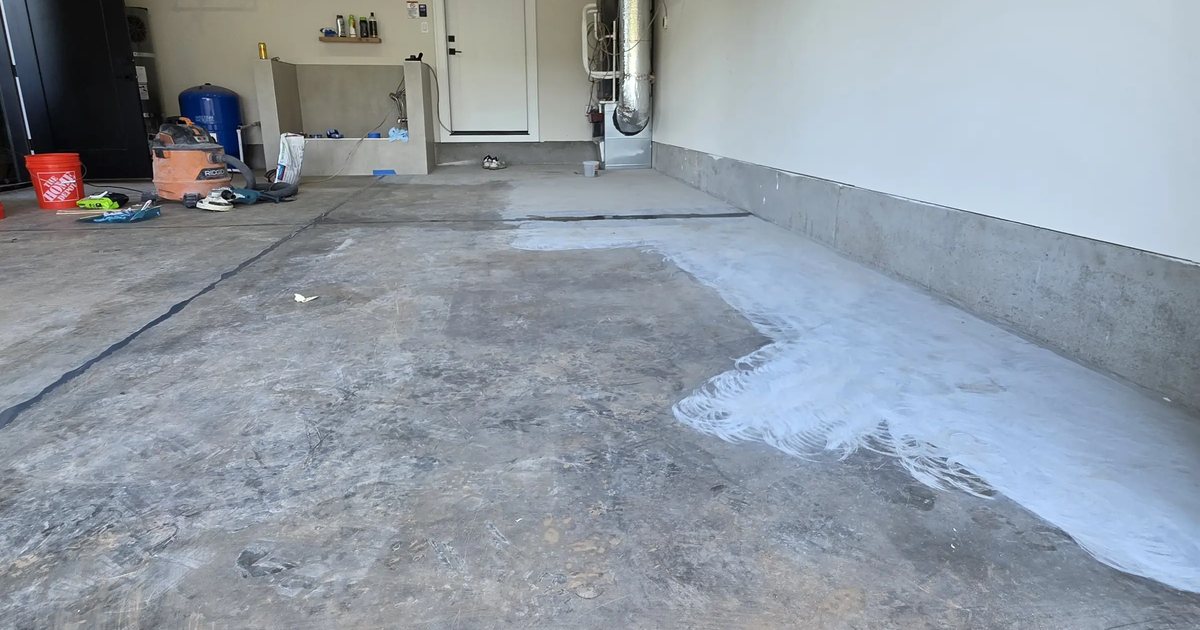
Many older garages around Vancouver still have a thin gray floor paint or a sealer from years ago. A garage that has held cars for decades also has oil in the pores. Taking the surface down mechanically removes the most contaminated layer and opens up fresh concrete for the base coat to grab. Acid etching will not remove old floor paint, and it does not pull out the oil-soaked top layer. Rolling a new coating over paint or oil is one of the fastest ways to get peeling later. On a big open floor we usually shot blast thin old coatings off, and we grind along the walls and in tight spots. Removing an old coating or paint is included in the written quote after we inspect the floor in person.
Acid etching instead of mechanical prep
Acid etching is a chemical wash that some installers and most home-center kits use because it needs no grinding equipment. It is quick, and it is one of the corners that gets cut on fast, low-cost installs. We never acid etch. It does not reliably remove sealers or the weak surface layer. It leaves residue that has to be fully neutralized and rinsed, and it puts water on a slab that then has to dry before coating. It does not create the open, clean profile a 100% solids epoxy base needs to bond. On do-it-yourself floors, peeling often starts at the edges and control joints, then spreads, because an acid-etched slab does not grip the coating well. Skipped prep, not bad product, is behind most coating failures, and acid etching is a form of skipped prep.
A thin coating with no real system under it
A typical kit is a water-based or solvent-cut epoxy and a small bag of flake. Most kits are a single product, with no separate polyaspartic topcoat. That kind of film can look glossy on day one and still have almost nothing holding it to the slab. A professional flake system uses a thick 100% solids epoxy base coat worked into the open profile of the concrete. Because it is 100% solids, the coating that goes down is the coating that stays; it does not shrink as solvents evaporate. Decorative flake is broadcast into the wet base until no more will stick, then locked down, then covered with a polyaspartic topcoat built to stand up to hot tires, oil, gas and household chemicals. Skipping the mechanical bond, or skipping the wear layer, leaves a thin film that scuffs, stains and lifts.
Cracks, weak spots and unchecked moisture
Cracks and spalls are filled with a polyurea repair compound and ground flush before the base coat goes down. Control joints are cleaned out and treated before we coat, not simply painted over. You can choose to have them filled flush for a seamless look or kept cut in for a traditional look. Painting over an open crack or a crumbling apron at the garage door leaves a weak point. The coating can bridge it for a time, then split or lift where the slab was never repaired. The area at the door often takes the most wear from water, grit and tires, and it is one of the first places a shortcut shows.
Damp spots on a slab are often vapor coming up through concrete with no barrier under it, especially on older floors. We test the moisture level and, when it is high, use a moisture-mitigating primer. If there is standing water or an active leak, that has to be solved first. A coating cannot fix an active water problem by itself, and trapping moisture under a film is a way to get bubbling or a failed bond. New concrete can also hold a lot of water for its first year or two, which is why a moisture test comes before coating on a fresh slab.
Rushed, one-day shortcuts
Most garages take 2 to 3 days on site, depending on size. Day 1 is surface preparation, crack repair, the epoxy base coat and the flake broadcast. Day 2 is scraping, the Flake Lock coat, which dries 3 to 4 hours, and then the polyaspartic topcoat. Larger garages can run into a third day. We do not skip coats to finish in one day. One-day installs get their speed by cutting corners, and on an older slab the corner that matters most is prep.
What Dustless Shot Blasting Actually Does
Dustless shot blasting throws steel abrasive at the slab to clean and profile the concrete so a coating can mechanically bond. The machine fires steel shot at the surface and recovers the shot, the dust and the loosened material with a vacuum as it goes. It is a dry process, not a wash.
That matters for two reasons. First, it removes what is sitting on top of the slab: the weak surface layer, thin old coatings such as gray floor paint, sealers and contaminants. Second, it leaves a uniform, open, textured profile. The 100% solids epoxy base coat is then worked into that profile, so the system locks into the concrete instead of perching on a smooth skin.
Shot blasting suits larger, open slabs and removing thin old coatings. It covers open floor quickly and evenly, which is why it is our pick for the field of a typical two-car garage once cars, storage and loose debris are out of the way. Both shot blasting and diamond grinding run with vacuum dust collection. Homeowners sometimes worry about dust drifting into the house. The shot and the loosened concrete stay inside the machine’s recovery system as the work moves across the floor.
How Diamond Grinding Fits Alongside It
Shot blasting is not the only tool, and it is not the right tool for every square foot. Diamond grinding uses rotating heads fitted with diamond segments to cut into the surface of the concrete. It removes sealers, coatings and the weak top layer, takes down high spots, reaches edges and tight spots, and grinds repairs flush with the surrounding slab. It is our pick along walls, around steps, next to a water heater platform, and anywhere the shot-blast machine cannot reach.
On many floors the two methods work together: shot blasting across the open field of the slab, with diamond grinding at the edges and in tight areas. We choose the right method for each space. For how that choice plays out on older local slabs, including oil-soaked ranch garages and leftover gray paint, read Garage Floor Coatings in Hazel Dell, WA.
| Dustless shot blasting | Diamond grinding | Acid etching | |
|---|---|---|---|
| How it works | Steel shot fired at the slab and vacuumed back up, along with dust and loosened material | Rotating diamond tooling cuts the surface | A chemical wash on the surface |
| Best for | Big open slabs and stripping thin old coatings | Edges, corners, tight spots, high spots, and grinding repairs flush | Nothing we install |
| Removes thin old floor paint | Yes | Yes | No |
| Mechanical profile for bonding | Yes | Yes | No |
| Runs with vacuum dust collection | Yes | Yes | No — it adds water that then has to dry |
| Do we use it? | Yes, chosen per space | Yes, chosen per space | Never |
The last row is the one that matters if you are comparing quotes. If a proposal skips mechanical prep in favor of an acid wash, you are being offered the same weak bond that peels under hot tires.
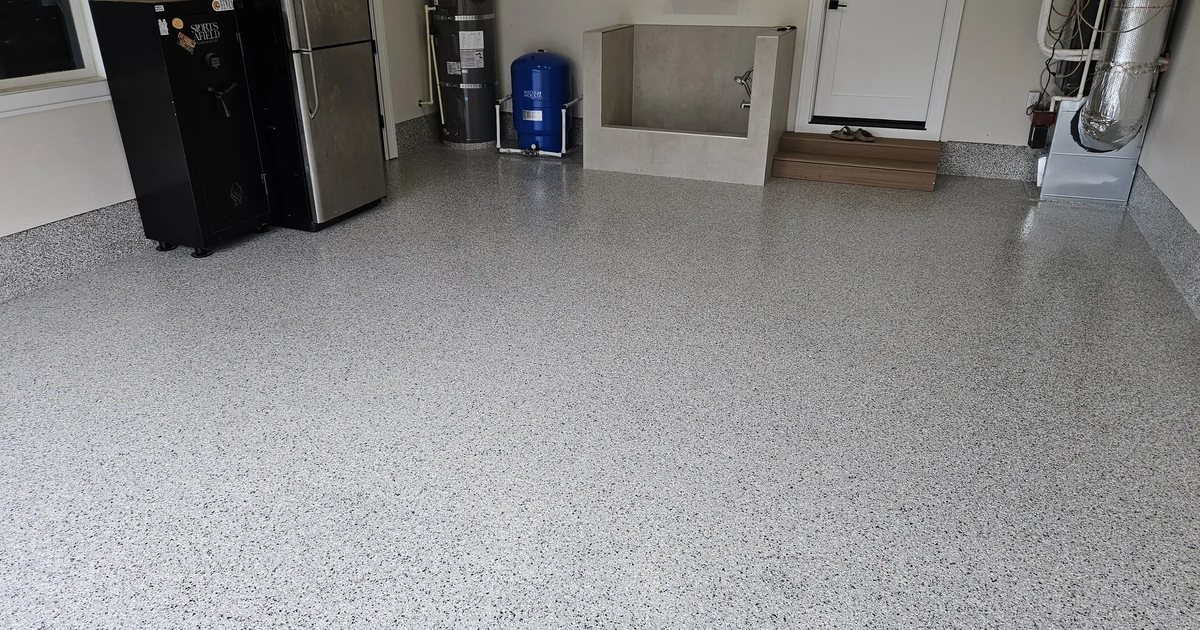
The layers we install after the slab is opened up. Prep is the bottom of the system, not an optional extra.
What Happens After the Slab Is Opened Up
Once the concrete is clean and profiled, and cracks and spalls are repaired, the flake system goes on in order: the 100% solids epoxy base, a full flake broadcast, the Flake Lock coat, and the polyaspartic topcoat. The base coat bonds the system to your concrete. The topcoat takes the daily wear so the layers underneath stay protected. You can walk on the floor a day or two after we finish, and park on it in about a week, once the topcoat is fully cured. Cold weather can add a little time. We give you the exact timing for your floor when we wrap up.
How We Choose the Prep for Your Garage
We do not pick a method from a menu before we see the slab. We inspect the floor in person, then choose. A large open slab with thin gray paint is a classic shot-blast job, with grinding at the edges. A tighter garage with more corners, steps or fixtures gets more grinding. A bare slab with years of oil still needs the contaminated surface taken down mechanically. High spots get ground. Repaired cracks and door aprons are ground flush either way.
If an old, failing coating has to come off first, removal is included in the written quote. The type of coating, how well it is bonded and the condition of the slab underneath all change the work, which is why the quote comes after the inspection, not before. A quote depends on prep and the condition of the concrete. We would rather tell you what your slab actually needs than guess from a photo of a clean corner.
If your garage floor is peeling, painted or still bare concrete, we will inspect it in person and explain the prep it needs before any coating goes down. Call or text (360) 685-7222, or request an on-site estimate.
Why This Prep Is Part of a Written Warranty
Every coating we install carries our 5-year workmanship warranty, in writing. That warranty relates to the quality of our installation, including preparation and the coats we applied. A workmanship warranty can stand behind a floor that was mechanically prepared, repaired and built as a complete system. It cannot honestly stand behind a film rolled onto paint, oil or an acid-washed slab.
That is one reason skipped prep shows up later as both a failure and an argument about who is responsible. We would rather do the unglamorous part — opening the concrete, repairing what needs repair, and building the coats in the right order — than explain a peeled floor after the fact. For what the written warranty covers and what it usually does not, read What a 5-Year Workmanship Warranty Covers (and What It Doesn't).
Questions Worth Asking Any Garage Coating Installer
- How will you prepare my concrete: dustless shot blasting, diamond grinding, or something else?
- Do you ever acid etch?
- If there is old paint, sealer or a failing coating, is removal part of the written quote?
- Do you repair cracks and spalls and grind them flush before the base coat?
- Is the system a 100% solids epoxy base with a separate polyaspartic topcoat, or a single thin coating?
- Do you provide a written workmanship warranty, and for how long?
Clear answers to those questions tell you more than a sample board alone.
Frequently Asked Questions
Why do garage floor coatings peel?
Peeling almost always traces back to poor preparation. If the slab still has a weak top layer, old paint, sealer or oil, or if it was only acid etched, the new coating sits on the surface instead of locking into the concrete. Hot tires, moisture and daily use then lift that film.
What is dustless shot blasting?
Dustless shot blasting throws steel abrasive at the slab to clean and profile the concrete so a coating can mechanically bond. The machine fires steel shot at the surface and vacuums the shot, dust and loosened material back up as it goes. It is our pick for big open slabs and for stripping thin old coatings.
Is shot blasting better than diamond grinding?
They do different jobs, and we use both. Shot blasting suits larger, open slabs and removing thin old coatings. Diamond grinding handles edges, corners, tight spots and high spots, and it grinds repairs flush. Many garages get some of each. Both run with vacuum dust collection.
Do you ever acid etch a garage floor?
No. We never acid etch. Every floor is prepped mechanically, by shot blasting or diamond grinding, so the coating has an open, clean surface to bond to.
What is hot tire pickup?
Hot tire pickup is when a warm tire softens a thin coating and pulls it off the concrete as it cools. It happens to thin coatings put down on concrete that was never properly prepared.
Does every 360 Surfaces garage floor get mechanical prep?
Yes. We prepare every slab by diamond grinding or dustless shot blasting and choose the right method for each space. We repair cracks and spalls before the base coat goes down. That prep is part of the installation our 5-year written workmanship warranty stands behind.
Request an Estimate
We will inspect your garage slab, explain the prep it needs, and give you a written quote after we see the floor in person. Call or text (360) 685-7222, email info@360surfaces.com, or request an on-site estimate.
360 Surfaces
Published November 8, 2026