A split-level in Cedar Hills or Raleigh Hills has a garage that sits half a level below the house, and where the slab meets the step there is a cold joint that has been cracking since 1974. That joint is the thing to get right. Fill it wrong and the crack comes through the coating in a year. We route it, fill it with flexible polyurea, and grind it level so it moves without breaking the floor above it.
That is one end of Beaverton. The other end is a 2020 house toward Cooper Mountain with a slab still carrying builder sealer and enough moisture to fail a test. In between are the 1990s two-stories on Murray Hill and Sexton Mountain with ordinary tire-worn concrete. We are about 40 minutes west on Highway 26, and we see all three in a single week's run through town.
One System, Three Generations of Concrete
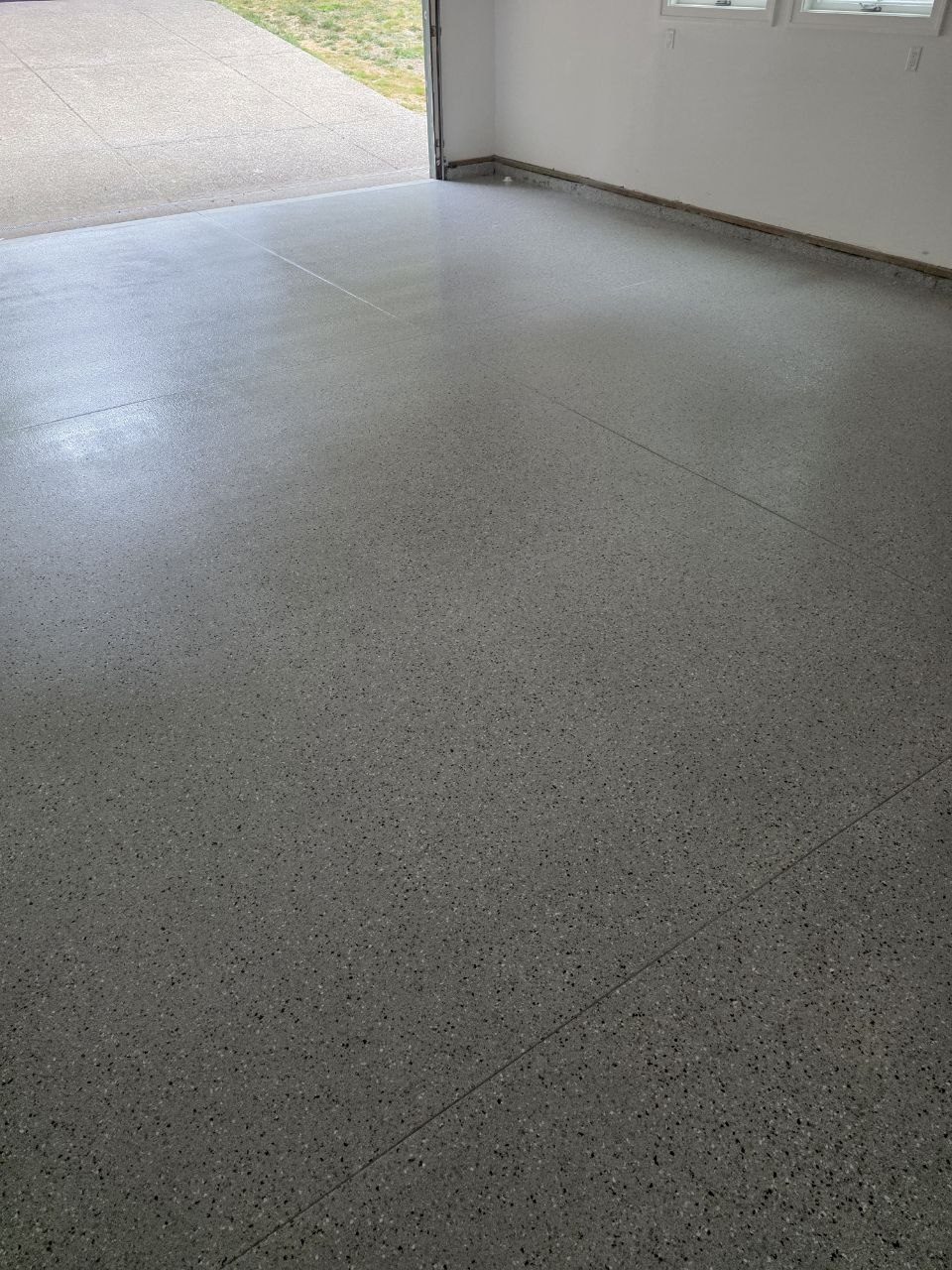
The floor we install is the same on a 1965 slab and a 2020 slab: 100% solids epoxy over diamond-ground or shot-blasted concrete, flake to refusal, a polyaspartic topcoat, 30 to 40 mils. What changes is everything before the base coat. Old Cedar Hills floors need paint ground off and cracks filled. Murray Hill floors need a grind and a joint fill. Cooper Mountain floors need the builder sealer and curing compound removed and a moisture test that often comes back high.
The west-side climate is the constant. Wet and gray from October through May, clay soil that holds water under every slab. So the moisture meter comes out at every Beaverton estimate, and a moisture-mitigating primer goes under the epoxy when the reading calls for it. The topcoat resists hot-tire pickup, which matters on the sunny south-facing garages up on Sexton Mountain where tires come in warm off the driveway.
Our Epoxy Flake Floors System
Materials: 100% solids epoxy base, full flake broadcast, Flake Lock, polyaspartic topcoat
Thickness: 30-40 mils
Install time: 2-3 days
Walk on it: 1-2 days after
Park on it: about a week after
Warranty: 5 years on workmanship
Hot-tire pickup resistant. Chemical and impact rated.