
Every epoxy flake floor we install starts long before any coating is mixed. The first part of every job is spent on the bare concrete: cleaning it, opening it up and getting it ready to bond. That step is called surface preparation, and on our floors it is done one of two ways: diamond grinding or shot blasting.
Homeowners ask us about the difference all the time, usually after reading that "prep is everything" without anyone explaining what prep actually is. This guide walks through both methods in plain language: what each machine does to the slab, the surface each one leaves, where each one works best, why most floors end up using a bit of both, and why acid etching is not part of our process.
The Short Answer
Both methods are mechanical. They physically remove the top of the slab instead of relying on chemicals. Diamond grinding uses spinning diamond tooling to abrade the surface, and it is the better tool for edges, tight spots, high spots and uneven concrete. Shot blasting throws small steel shot at the slab to fracture and roughen the surface, and it is efficient on larger, open floors and for removing thin old coatings and sealers. Both run with vacuum dust collection, and both leave an open, textured surface that an epoxy base coat can grip.
We prepare every slab by diamond grinding or shot blasting and choose the method for each space. On many floors the answer is a combination: one method across the open field of the slab and the diamond grinder along the walls, at the door and around anything the bigger machine cannot reach.
Why Preparation Decides Whether a Floor Lasts
A coating is only as strong as its bond to the concrete. The surface of a typical garage slab is not a good surface to bond to. When concrete is finished, the top layer is troweled smooth and dense, and it is often weaker than the concrete underneath. Over the years that surface collects oil, tire residue, sealers, curing compounds, paint overspray and the remains of anything that was ever spilled on it.
Put epoxy straight onto that surface and the coating ends up stuck to the dirt and the weak top layer, not to sound concrete. That is how floors end up peeling, lifting at the door or pulling up under hot tires. We wrote about those failures in detail in why garage floor coatings peel.
Mechanical preparation fixes this by doing three things at once:
- It removes what is on top. Sealers, old coatings, paint and surface contamination come off with the top of the slab.
- It exposes sound concrete. The weak, smooth top layer is taken off so the coating bonds to the solid material underneath.
- It creates a profile. The surface is left with a texture, a little like fine sandpaper, that the base coat can soak into and lock onto.
The industry has a standard way to describe that texture. The International Concrete Repair Institute (ICRI) publishes a concrete surface profile (CSP) scale, with physical reference samples that run from nearly flat to very rough. Coating manufacturers specify the profile their products need, and the prep method is chosen to reach it.
What Is Diamond Grinding?
A floor grinder looks a bit like a heavy-duty floor polisher. Underneath, it has rotating heads fitted with diamond segments: small blocks of industrial diamond held in a metal bond. As the heads spin across the slab, the diamonds scratch away the surface of the concrete, a thin layer at a time. Different tooling is used for different jobs. Coarser, more aggressive diamonds cut faster and leave a rougher surface, while other tooling is used to remove coatings or smooth the floor.
The grinder is connected to a vacuum, so the concrete dust is pulled into the vacuum as the machine works instead of being thrown into the air. Hand grinders with smaller diamond cups cover the edges along walls, the corners and the spots around water heaters, stairs and posts.
Diamond grinding is the right tool when:
- the slab has high spots, lips at joints or uneven areas that need to be taken down
- the floor has trowel marks, ridges or rough patches that would show through a coating
- the work is along walls, in corners or in tight areas that a larger machine cannot reach
- crack and spall repairs need to be ground flush with the surrounding concrete
- a thicker old coating or adhesive needs to come off with aggressive tooling
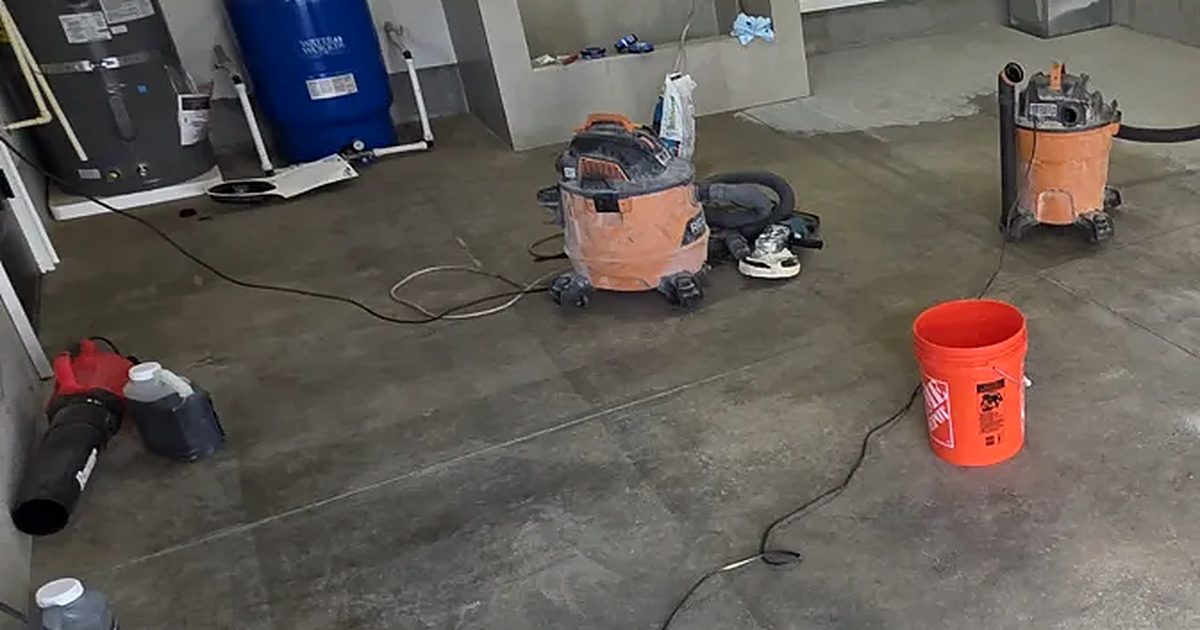
The photo at the top of this post is from one of our garage jobs mid-prep: the grinding is underway, the dust vacuums are still on the floor, and the hand grinder is sitting by the vacuum ready for the edges.
What Is Shot Blasting?
Shot blasting is simpler than it sounds. A shot blaster is a walk-behind machine with a spinning wheel inside. The wheel throws small steel balls, called shot, down at the concrete at high speed. When the shot hits the slab, it chips and roughens the surface, knocking off the weak top layer, thin coatings and anything stuck to it.
The machine is a closed loop. The shot bounces back up into the machine, where it is separated from the concrete dust and reused, while the dust is pulled into an attached vacuum. That is why shot blasting is a dry process with very little dust in the air when the equipment is set up and running properly. Nothing is wet, and there is no rinse water to dry out afterward.
The operator walks the machine across the floor in passes, a bit like mowing a lawn, and the speed of travel and the size of the shot control how aggressive the cut is. The result is an evenly textured surface across the open floor.
Shot blasting is the right tool when:
- the slab is a larger, open area where a walk-behind machine can make long, even passes
- thin old coatings, sealers or surface contamination need to come off
- the goal is a uniform texture across the main field of the floor
Because the blast head sits inside the machine body, a shot blaster cannot get all the way into a corner or tight against a wall. Those areas are finished with a diamond grinder.
Diamond Grinding vs. Shot Blasting: Side by Side
| Question | Diamond Grinding | Shot Blasting |
|---|---|---|
| How it works | Spinning diamond segments abrade the surface | Steel shot is thrown at the slab to chip and roughen it |
| Surface it leaves | An abraded, scratched profile; can also flatten the floor | An evenly textured, roughened profile |
| Best suited to | Edges, corners, tight spaces and smaller areas | Larger, open slabs |
| High spots and uneven concrete | Takes them down | Follows the existing surface; does not flatten it |
| Thin sealers and coatings | Removes them | Removes them efficiently |
| Thicker old coatings | Handled with more aggressive tooling | Depends on the coating; may need grinding as well |
| Along walls and around fixtures | Yes, with hand grinders | No; edges are finished by grinding |
| Repairs ground flush | Yes | No |
| Dust control | Vacuum dust collection | Built-in vacuum and shot recovery |
| Water or chemicals | None; dry process | None; dry process |
The table is the reason most good floors are not an either-or choice. A shot blaster is efficient across the open floor, but it cannot finish an edge or grind a patch flat. A grinder does both of those, and on a typical two- or three-car garage it may be the right tool for the whole slab.
How We Choose the Method for Your Floor
We do not pick a method before seeing the concrete. These are the things that decide it:
- The size and layout of the space. Large, open slabs suit shot blasting. Garages crowded with water heaters, stairs, posts, steps into the house and storage areas along the walls call for more grinding.
- What is on the surface now. Bare concrete, a clear sealer, a thin paint-type coating and a thick old epoxy each come off differently. If you are not sure what is on your floor, tell us what you know and we will look at it.
- How flat the slab is. High spots, lips at control joints and ridges need to be ground down, because a coating follows the shape of the concrete underneath.
- The repairs. Cracks, chips, spalls and worn door aprons are filled and then ground flush with the rest of the slab either way. See garage floor crack repair before coating for how that step works.
Why We Never Acid Etch
Acid etching is the prep step in most DIY garage kits, because it needs no equipment: mix, pour, scrub and rinse. It is also one of the most common reasons DIY coatings fail. Acid does not reliably remove sealers, curing compounds or oil, and it does not take off the weak top layer of the slab. It leaves residue that has to be neutralized and rinsed completely, and the rinse puts water into a slab that then has to dry out before anything is coated. The result is an inconsistent surface that is hard to judge by eye. That is why we prepare every floor by diamond grinding or shot blasting, and why we never acid etch. Our DIY vs. professional garage epoxy guide covers the other differences.
What Prep Does Not Fix
Good preparation is the foundation of a floor that lasts, but it is not a cure for every slab problem. Two things are worth knowing up front:
- Moisture coming up through the slab. Grinding and blasting open the surface; they do not stop water vapor moving up from the ground. Slab moisture is a separate issue, and it is one of the exclusions in our warranty.
- New cracks. Existing cracks are repaired during prep, but concrete can still crack later as a house settles. A coating cannot stop the slab underneath from moving.
What Happens After the Slab Is Prepared
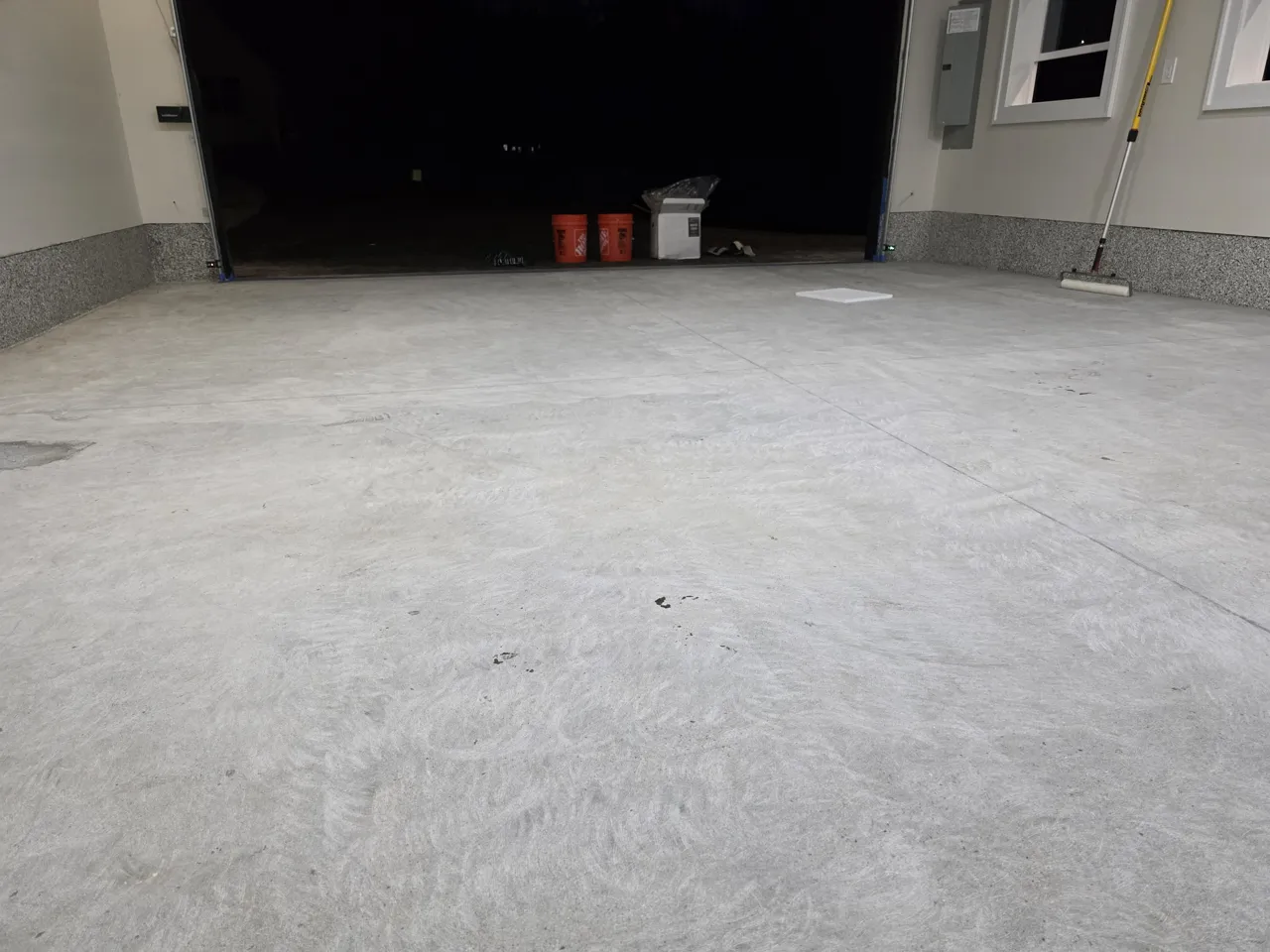
Once the slab is prepared, vacuumed and repaired, the flake system goes on in layers:
- A thick 100% solids epoxy base coat is spread across the slab and worked into the open profile left by the prep.
- Decorative flake is broadcast into the wet base coat until no more will stick, a full broadcast.
- After the base cures, loose flake is swept up, the floor is scraped, and a Flake Lock coat locks the flake in place.
- A clear polyaspartic topcoat is rolled over the entire floor as the wear layer.
The base coat is the layer that bonds the whole system to your concrete, which is why the prep under it matters so much. You can see every layer on our epoxy flake floors page, and if you are still deciding on the topcoat, read polyaspartic vs. epoxy.
Our Warranty
Garage, basement, shop, metallic and flake floors we install come with a lifetime warranty from 360 Surfaces. It covers peeling, lifting or flaking caused by our work or materials for as long as you own the home. It does not cover damage from impacts or chemicals, moisture coming up through the slab, or new cracks in the slab, and it is not transferable. Proper preparation is a big part of why we can stand behind our floors that way.
Frequently Asked Questions
Is diamond grinding or shot blasting better for a garage floor?
Neither is better on every floor. Shot blasting is efficient on larger, open slabs and for removing thin coatings and sealers. Diamond grinding handles edges, tight spots, high spots and repairs. Many garages use both, and some are ground entirely.
What is shot blasting concrete?
Shot blasting is a dry prep method in which a walk-behind machine throws small steel shot at the concrete to roughen it and remove the weak top layer, thin coatings and contaminants. The shot is recovered and reused, and the dust is collected by an attached vacuum.
Is concrete grinding dusty?
Our grinders run with vacuum dust collection, so the dust is pulled into the vacuum as the machine works. Shot blasters also have a built-in vacuum. Neither method uses water or chemicals.
Can I just acid etch my garage floor instead?
We never acid etch. Acid does not reliably remove sealers or the weak top layer of the slab, it leaves residue that must be neutralized and rinsed, and it puts water into the slab before coating. Diamond grinding or shot blasting gives a cleaner, more consistent surface for the epoxy to bond to.
Does a new concrete slab still need grinding or shot blasting?
Yes. New concrete has a smooth, dense troweled surface and often a curing compound or sealer on top. It still needs mechanical preparation so the epoxy bonds to sound concrete instead of the surface layer.
Get a Garage Floor Price
We install epoxy flake floors with polyaspartic topcoats on garages, shops and basements across Vancouver WA and Clark County, and every one starts with diamond grinding or shot blasting. See your garage price online in about 90 seconds, or request an estimate and email info@360surfaces.com. Your final price is confirmed after we see the slab.
360 Surfaces
Published November 21, 2026
Where We Do This Work
Epoxy flake garage floors across Clark County and the Portland metro:
Vancouver, WA · Camas, WA · Battle Ground, WA · Ridgefield, WA · Salmon Creek, WA · Washougal, WA · Brush Prairie, WA · Hazel Dell, WA · La Center, WA · Longview, WA · Portland, OR · Lake Oswego, OR · Beaverton, OR · Happy Valley, OR · West Linn, OR · Hillsboro, OR · Tigard, OR · Gresham, OR